The sterea skia cycle of works, which Tim Otto Roth has exhibited at venues including the lichtsicht5 projection biennial in Bad Rothenfelde, the Goethe Institute in Washington or the Bauhaus Festival at the Berlin Academy of Arts, presents hyper shadows in various constellations and media contexts. Through a simple intervention, the conceptual artist and composer succeeds in expanding seemingly flat shadows into three-dimensional virtual spaces in an almost magical way.
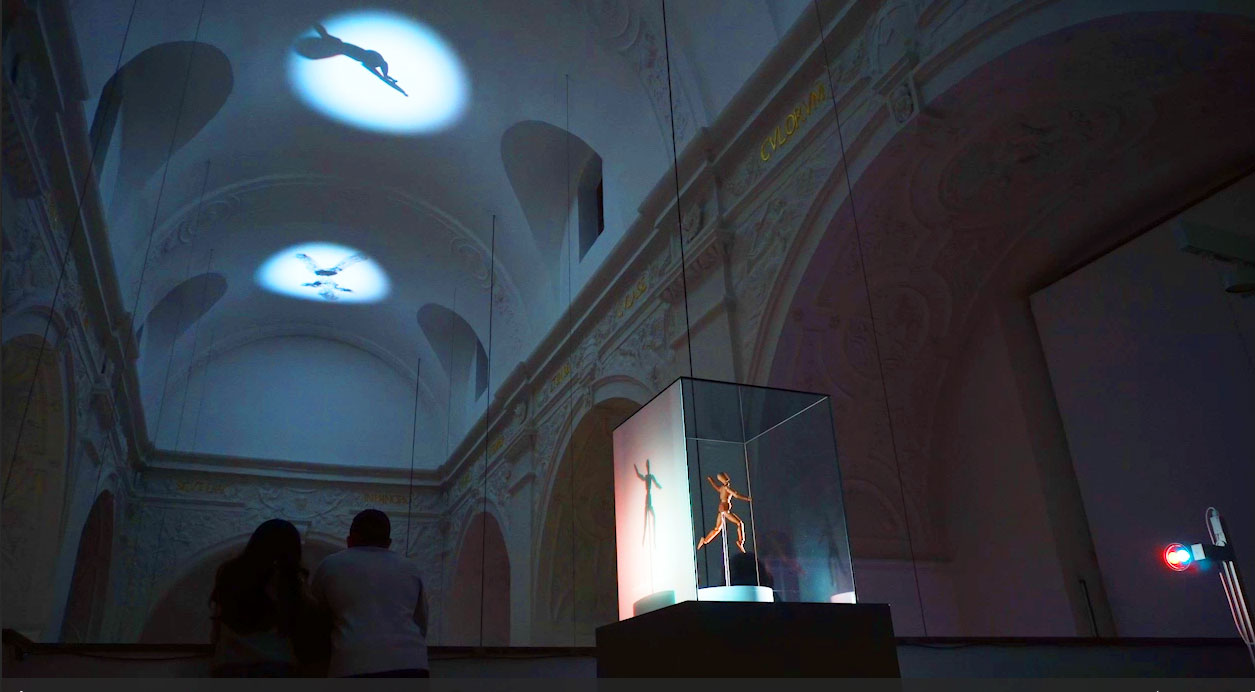
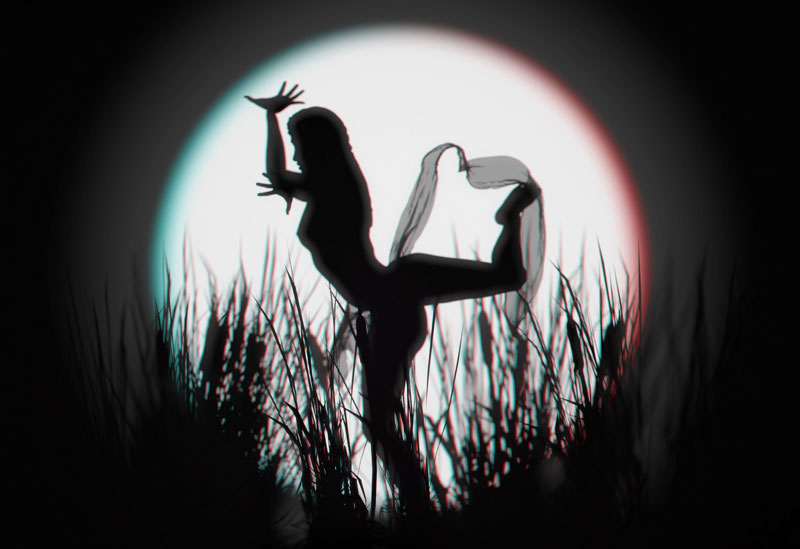
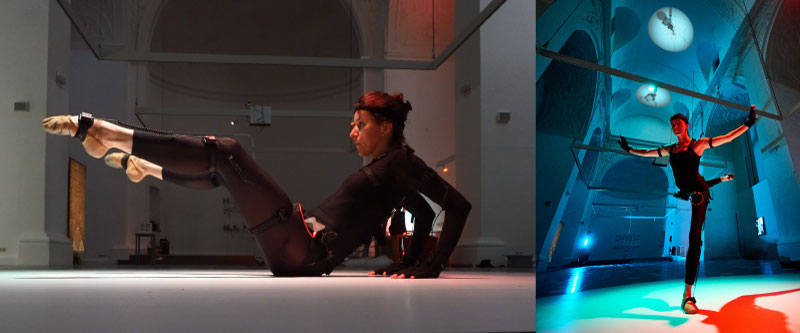
Shadow dance 'scarbo pirouettant' at the exhibition 'Logical Fantasies', Kunsthalle Jesuitenkirche, Aschaffenburg, 2020
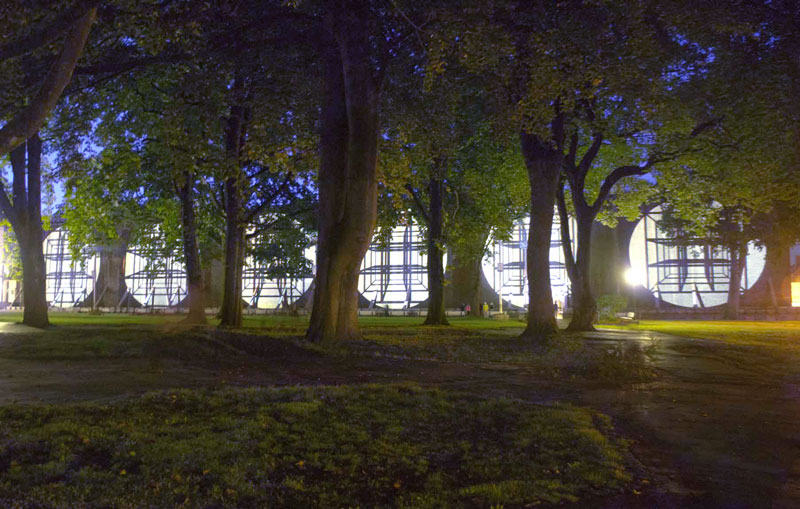
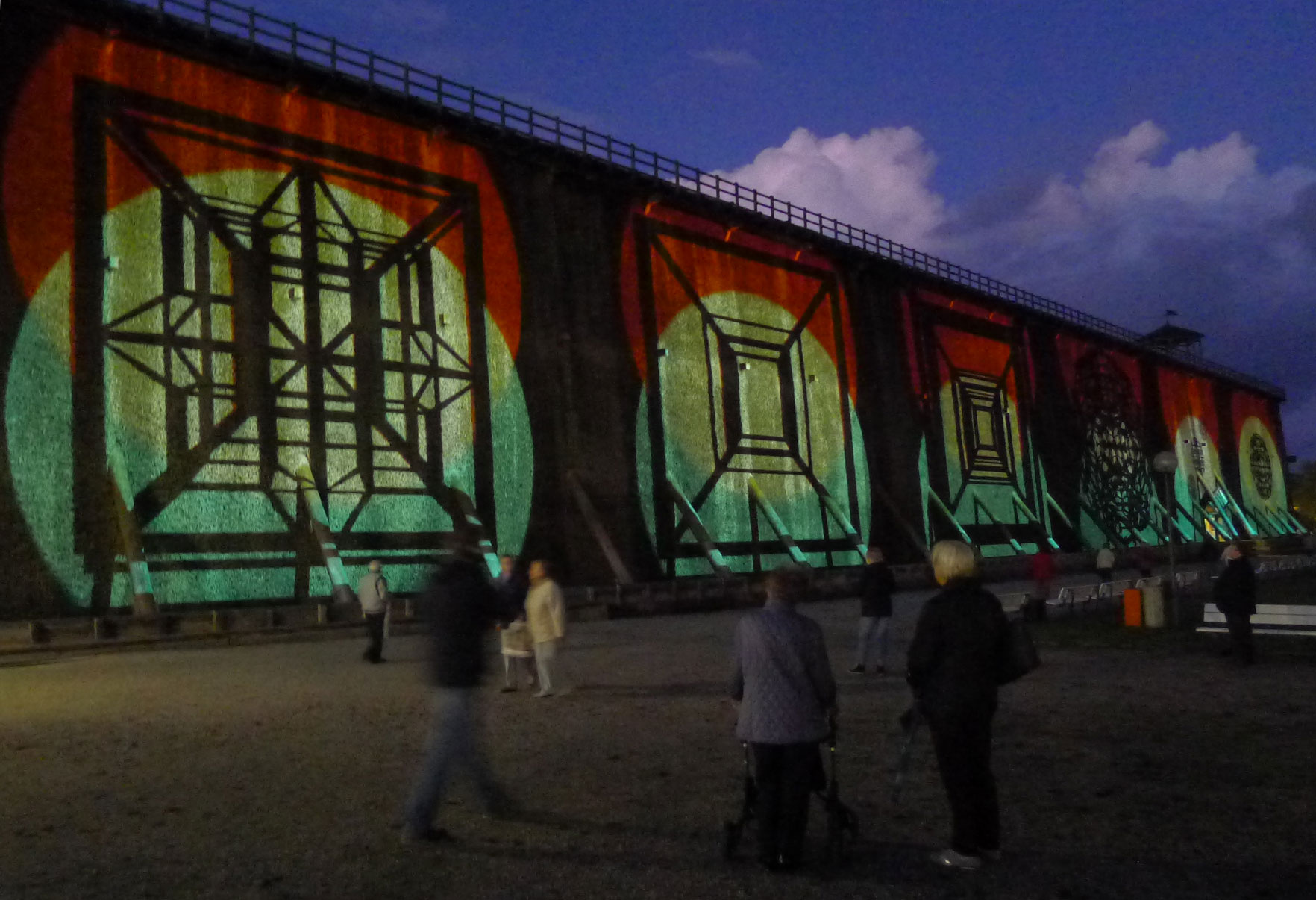
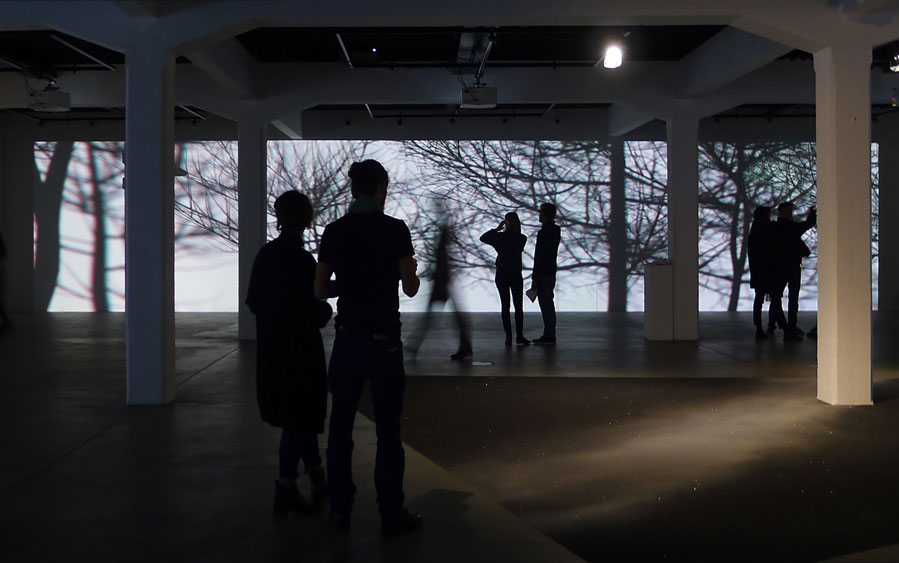
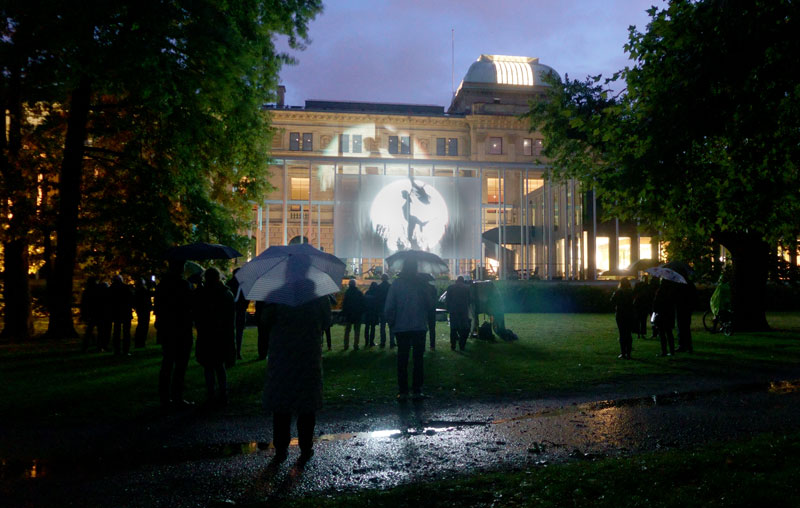
Opening of the lichtsicht5 projection biennial, Bad Rothenfelde. The 100-metre-wide projection onto the graduation tower can be seen through the trees.
2015: opening lichtsicht5 Projektionsbiennale, Bad Rothenfelde
Opening 'XX or 'Mummelsee in der Pfanne'', Städtische Galerie, Offenburg, image: Wilfried Beege
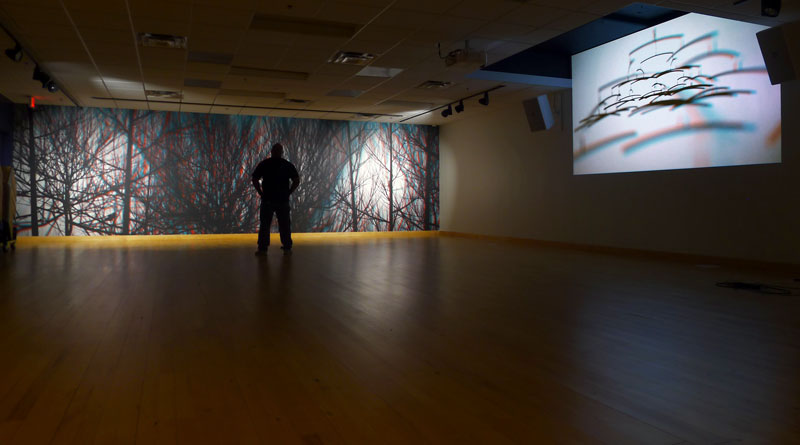
Exhibition view 'Die zweite Natur. Artistic reflections on nature in the digital age', House of Electronic Arts (HEK), Basel, 2016
Exhibition 'Light from the Other Side', Goethe Institut Washington, US, 2017
'Sun on Stage' during the festival '100 jahre bauhaus', Akademie der Künste, Berlin, 2019
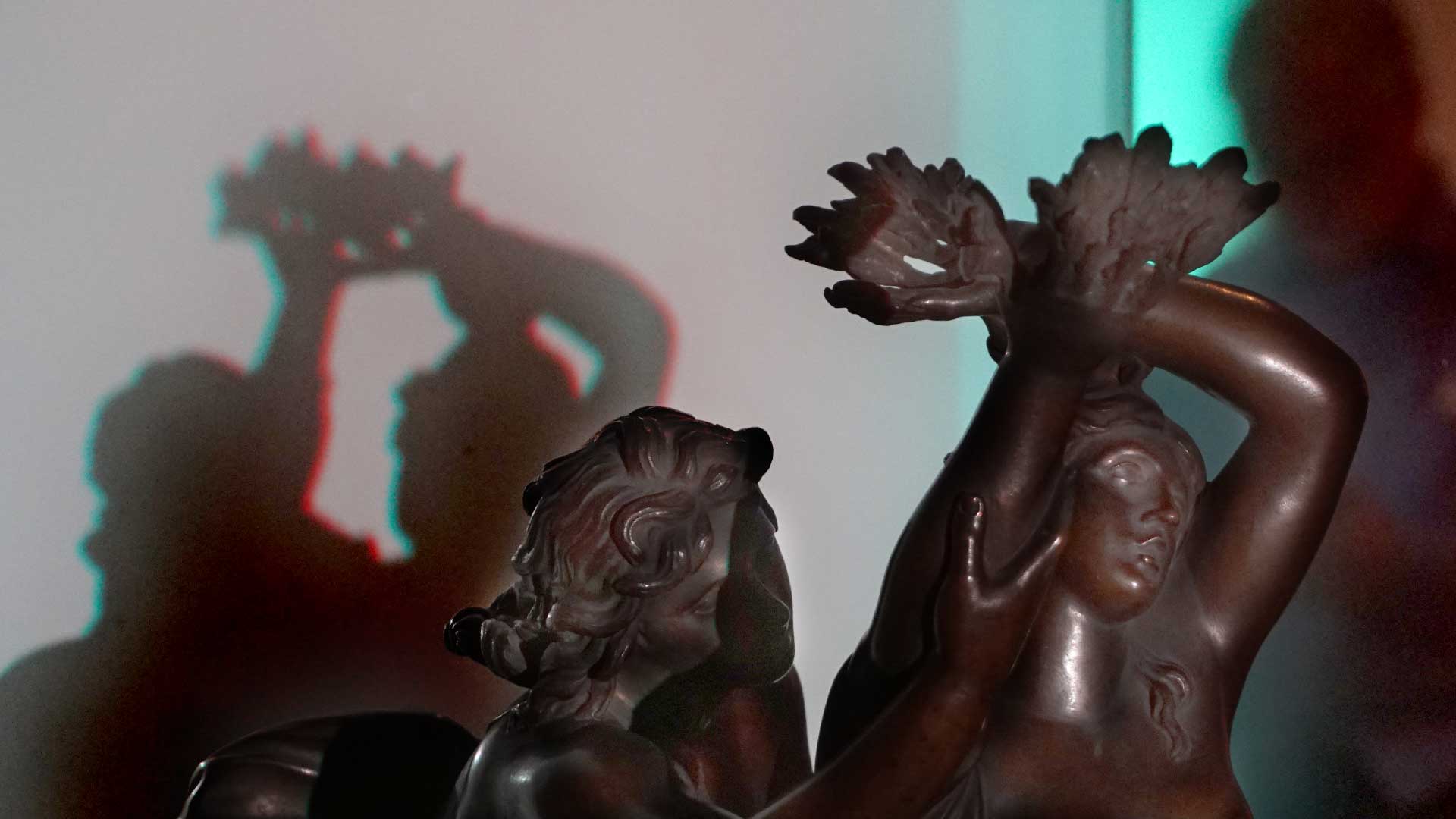
2022: Shadow opera 'Nymphomania', Herzog Anton Ulrich-Museum, Braunschweig
2022: Shadow opera 'Nymphomania', Herzog Anton Ulrich-Museum, Braunschweig
Over the past 15 years, Roth has consistently pursued his research into hypershadows. With his shadow narratives, he transcends the boundaries of artistic disciplines as 'expanded shadow cinema': What originally began as a stereoscopic projection experiment on photographic material, he now composes – as most recently in Nymphomania – incorporating architectural, dance and musical elements into a socially critical shadow opera in which the shadow literally loses its innocence.
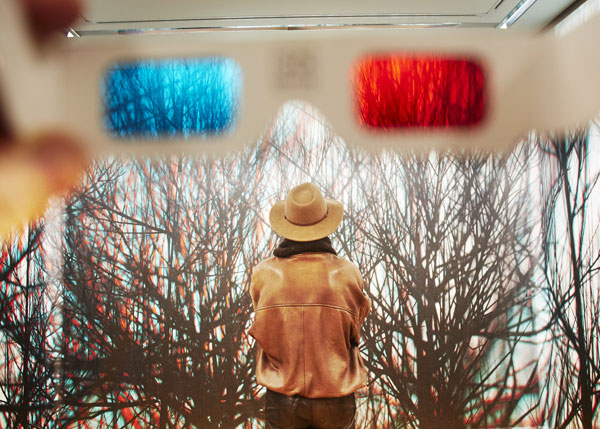
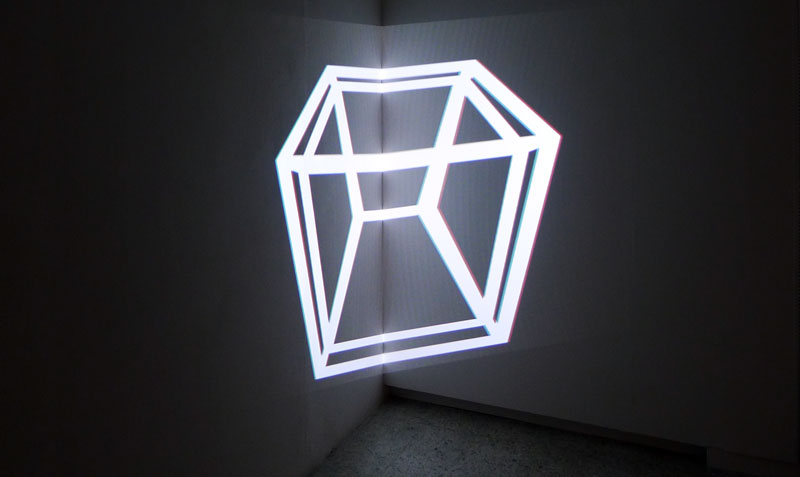
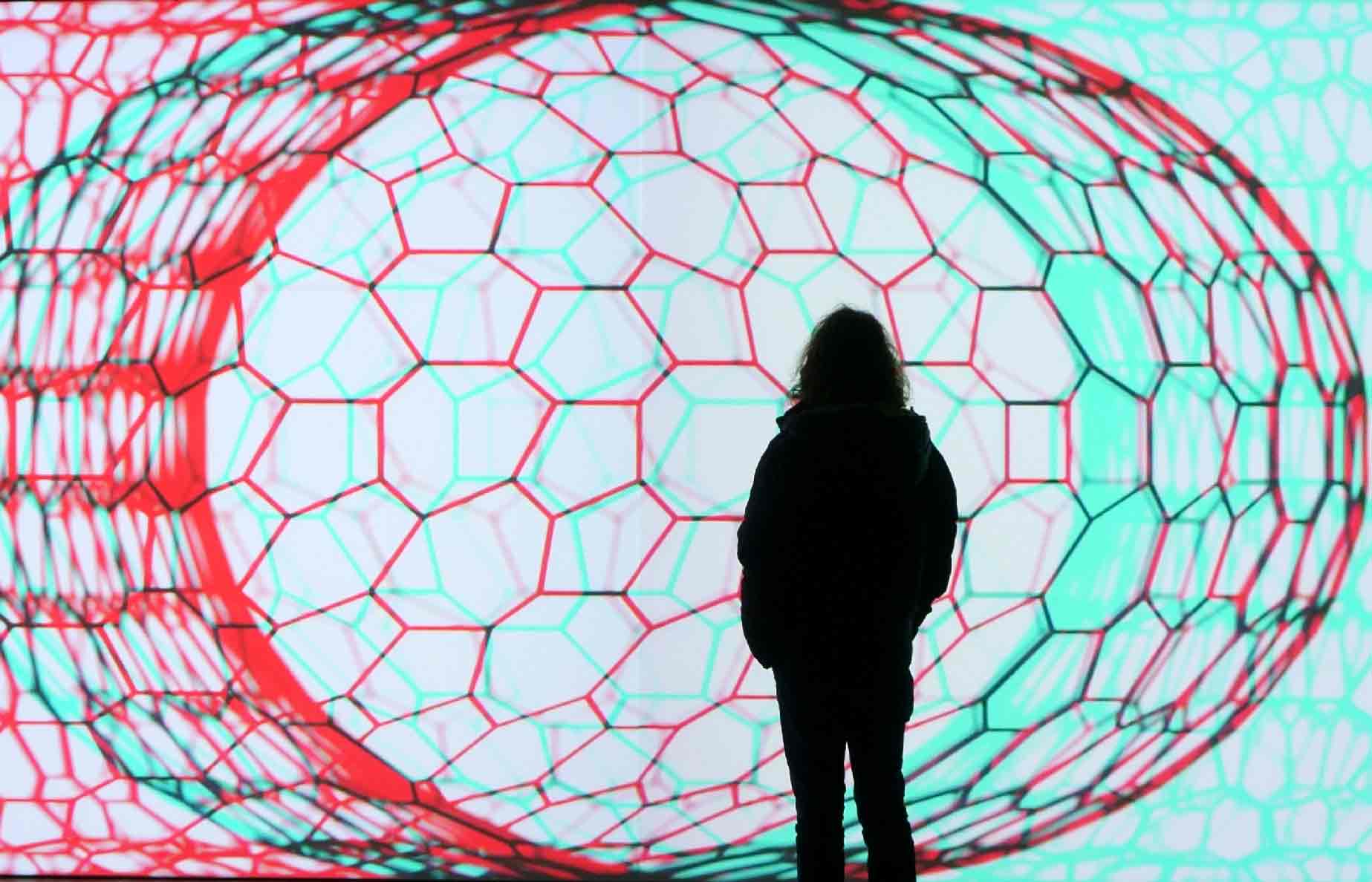
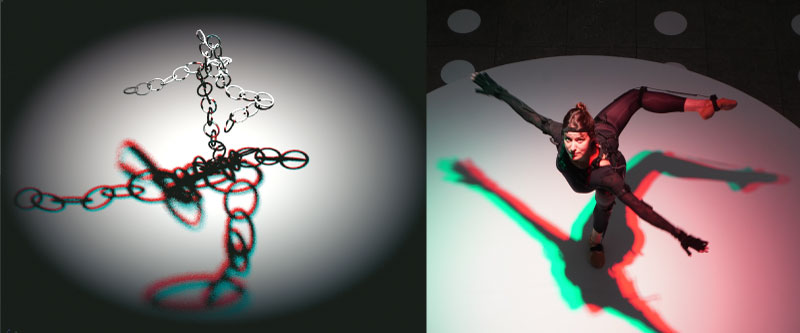
Concept With this cycle sterea skia, Tim Otto Roth reinterprets the ancient myth of the discovery of painting, in which Butades, the potter's daughter, is said to have traced the shadow of her lover with a pen, thus creating the first picture. Roth also captures shadows, but in dual form, illuminating objects with two light sources. One is red, the other is blue, both slightly offset from each other. The resulting overlapping shadow doubles are characterised by red and blue edges of varying widths, depending on the spatial constellation. When viewed through red-blue glasses, a small miracle unfolds: the stereo shadows detach themselves from the two-dimensional image plane and flip either in front of or behind the image plane, thus developing their own spatial existence. This anaglyphic process also gives the cycle its name: Skia stands for shadow in Greek, while sterea means spatial.
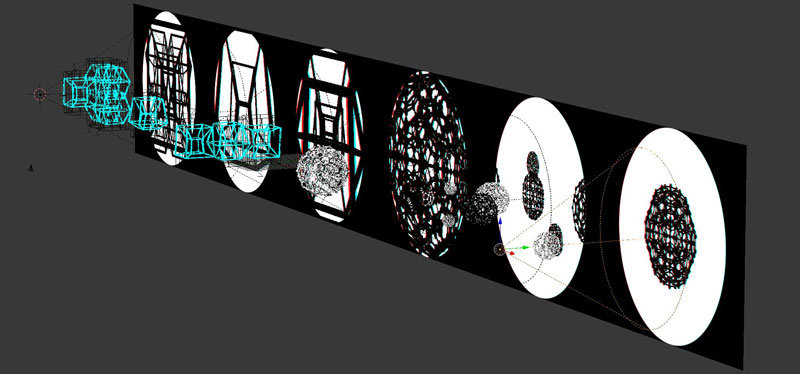
Analogue & digital – from photochemical to virtual traces Roth applies this simple but fascinating anaglyphic process in a classic way to light-sensitive material such as Polaroids or sheet film. The use of computer-based 3D techniques, on the other hand, not only allows stories to be told with animations, but also enables elaborate shadow scenarios to be staged that could not be realised physically on a real theatre stage, for example.
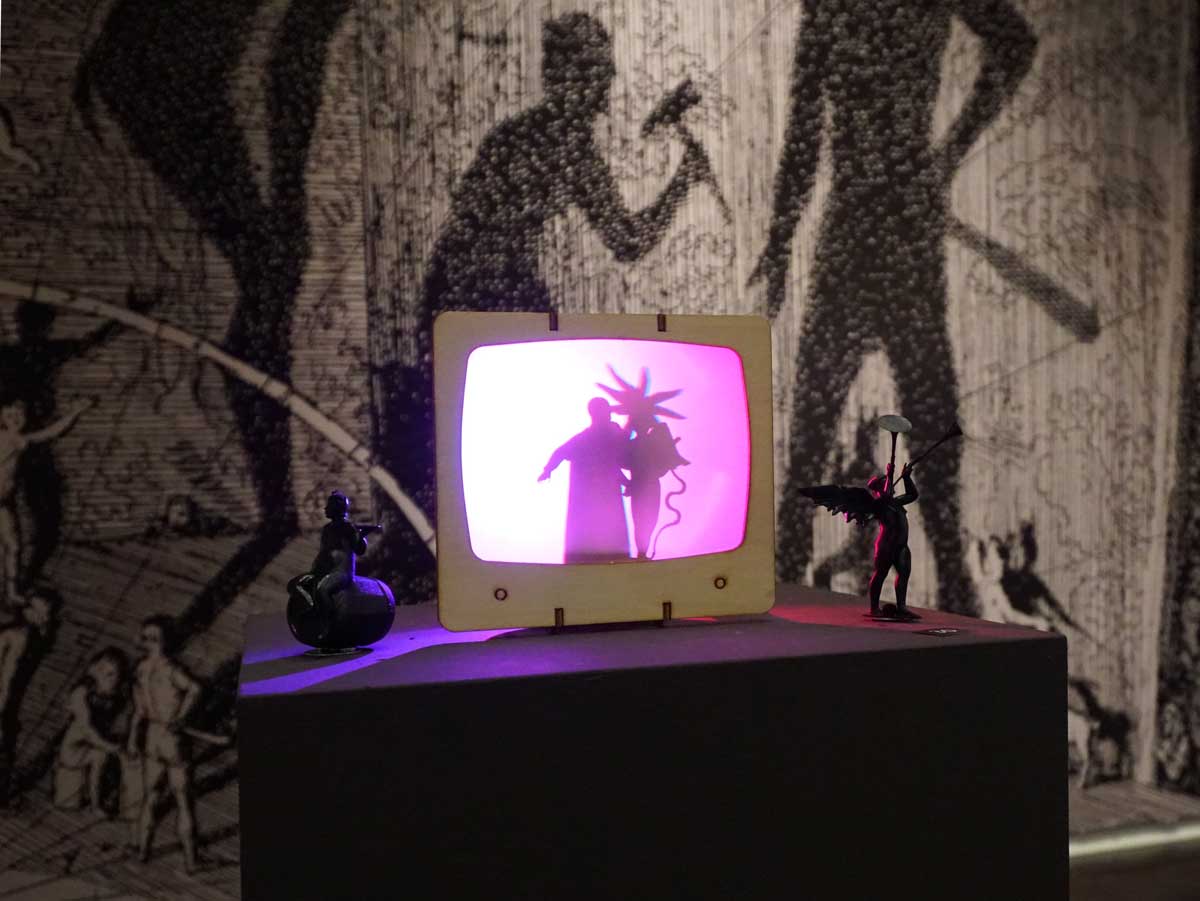
Shadow worlds Tim Otto Roth has explored the diverse possibilities offered by the sterea skia process in a wide variety of commissioned works. While he recreated a street in Bad Rothenfelde for the lichtsicht5 projection biennial, he designed an imaginary stage with a subtle shadow play featuring well-known Bauhaus motifs for the Bauhaus Festival at the Academy of Arts in Berlin in 2018. At the Wallraf-Richartz Museum, he recreated the characters from an early modern copperplate engraving of Plato's Allegory of the Cave as small sculptures and had them rotate in a miniature shadow theatre. For the Herzog Anton Ulrich Museum in Braunschweig, he developed Nymphomania, a shadow opera in which a Baroque bronze sculpture became the centrepiece of a gender-critical examination of the story of Daphne and Apollo from Ovid's Metamorphoses.
Shadow dances
Dance has repeatedly played a significant role in the exploration of shadow spaces through choreographed motion sequences. The most radical shift occurs in Scarbo , where viewers experience three figures in the church vaults from below, at a height of 18 metres. This requires a spatial rethinking of the motion sequences – not horizontally into the depths of the stage space, but as a vertical interplay of distance and proximity to the floor.
For these extremely demanding animated shadow dances, Roth collaborates with former Munich State Ballet soloist Zuzana Zahradníková, who has a repertoire that encompasses modern, classical and baroque dance. The choreographies are recorded in advance in the studio using motion tracking, so that figures such as a baroque bronze sculpture can then be literally animated. Whether it is Maurice Ravel's Gaspard de la Nuit (1908) or his own adaptation of Marco da Gagliano's opera La Dafne (1608), these dancing shadow worlds develop their own unique aesthetic through the combination of music, movement and narration, transporting viewers into unknown worlds.
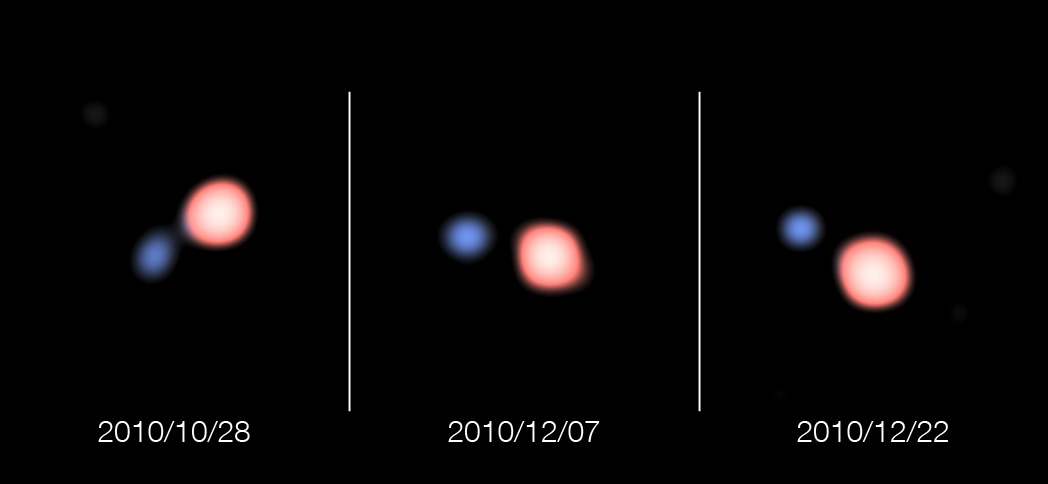
Thought experiment The phenomenon of shadows has repeatedly inspired artists. Who is not familiar with Adelbert von Chamisso's novella in which Peter Schlemihl sells his shadow? The sterea skia cycle is not inspired by the question of how a person without a shadow is perceived, but by a twofold thought experiment: it combines Leibniz's reflections on a Drôle de l'Ombre with the mental exercise of how our everyday perception would change if we and the world around us cast a double shadow. This could be the case, for example, if the Earth were illuminated not by one but by two suns of different colours. This is not so unlikely, given the fact that the vast majority of solar systems consist of multiple stars. Sterea skia thus encourages us to take a fresh look at the supposedly familiar shadows that surround us every day, which, from an astrophysical point of view, constitute the great exception.
Double star SS Leporis recorded by the VLT interferometer at the Paranal Observatory
in Chile. Credit: ESO/PIONIER/IPAG